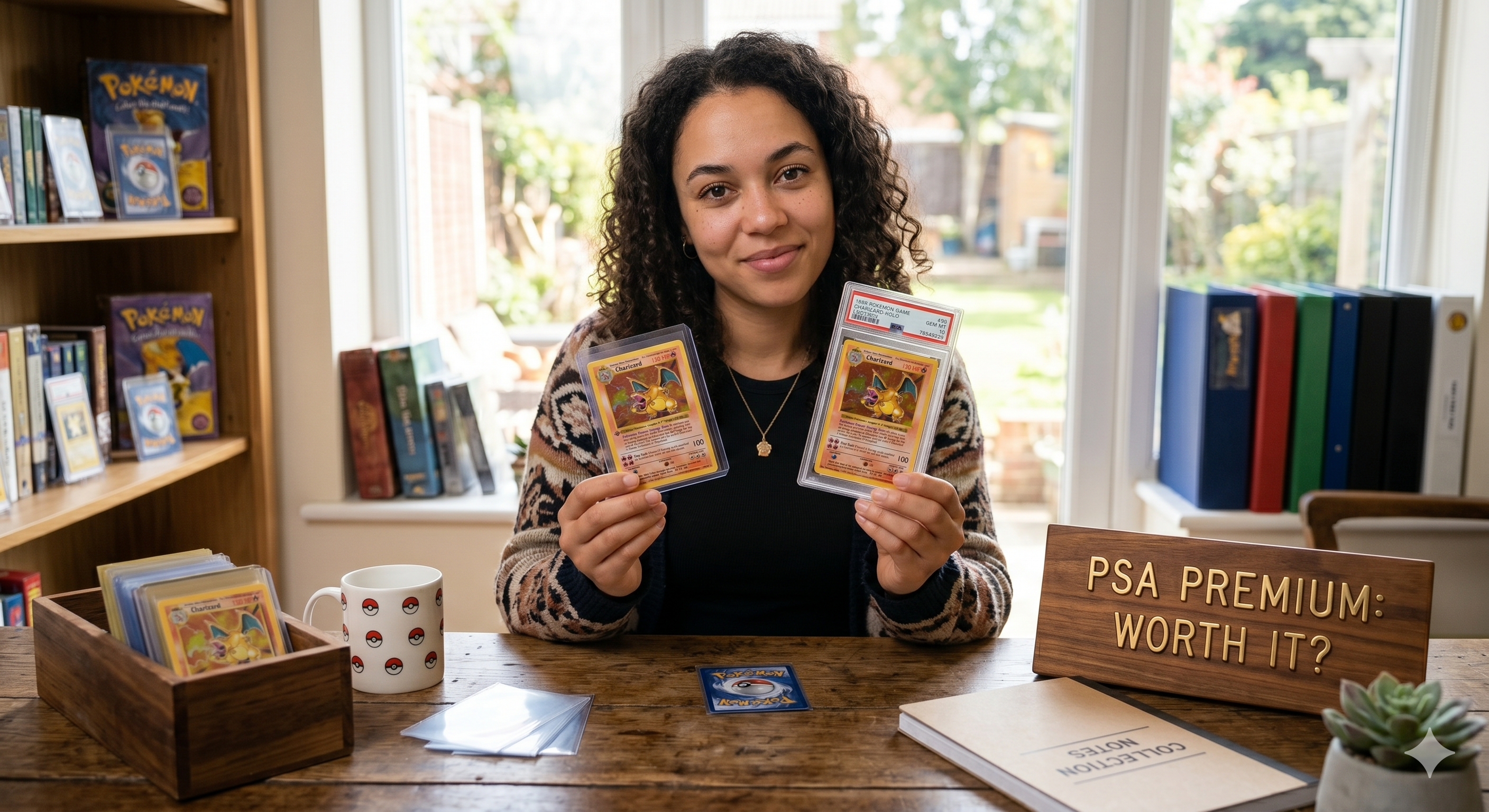
Walk into any Pokémon eBay listing and the same card can sit at wildly different prices depending on whether it’s been graded. A Charizard raw might trade for £80. A PSA 10 of the same card can clear £400. The premium for a single number on a plastic slab — Gem Mint vs ungraded — can be 3x, 5x, sometimes 10x.
So when does it actually make sense to pay it? And on the flip side, when is it worth grading a raw card you already own?
This is one of those questions where the answer depends on a few inputs: card value, your time horizon, your risk tolerance, and what the card looks like under proper inspection. Here’s how to think about it.
What you’re actually paying for in a graded card
A graded card is three things bundled together:
1. Condition certified by a third party. PSA, CGC, BGS, and the rest grade against published criteria — corner sharpness, edge wear, surface condition, centring. A 9 means something specific. A 10 means something stricter still. You’re paying not to have to assess condition yourself, with all the photo-zoom-and-pray that involves.
2. Authenticity guaranteed. A real, slabbed PSA 10 cannot be a fake. The grader has verified the card. For high-value vintage cards (Base Set, neo-era, Japanese promos), this alone often justifies the slab — fake Charizards have flooded the market for years.
3. Liquidity and resale ease. A graded card with a known comp price is far easier to sell than a raw card whose condition the buyer has to take on faith. Many serious collectors won’t buy raw above a certain price point.
Those three things — certified condition, authenticity, liquidity — are what you’re paying the premium for. Whether it’s worth it depends on the card.
When buying graded makes sense
High-value vintage cards. If you’re buying a 1999 Base Set Charizard, buying a PSA-graded copy is almost mandatory. The fakes market is sophisticated, and a raw card at that price point — even from a reputable seller — carries authenticity and condition risk that the grading premium covers. The graded premium is the insurance policy.
Cards you don’t intend to inspect physically. When you buy from eBay (especially internationally), you’re trusting photos. Photos can hide whitening, surface marks, and centring issues. A graded card removes that uncertainty.
Cards you might resell. If there’s any chance you’ll move the card on later, buying graded means you’re buying liquidity. A PSA 9 has a known market price and clears in days. A raw card claimed to be “Near Mint” takes longer to sell and almost always at a discount.
The flagship of your collection. If a card is the centrepiece — the one you’ll display, the one you tell people about — the slab adds presentation value beyond the financial argument.
When buying raw is the smarter call
Modern cards (post-2020) you intend to keep. Modern Pokémon cards are mass-produced. The print quality is generally high. If you’re buying a card you’ll keep in a binder and never resell, the graded premium is largely wasted spend — you’re paying for liquidity you’ll never use.
Cards under about £50. The break-even math (covered below) rarely favours grading on lower-value cards. By the same logic, buying raw at this tier saves the premium someone else is paying.
Cards you can inspect in person. If you’re buying at a card shop or a local sale, you can verify condition yourself. The slab’s main value evaporates.
When you’re confident in the seller. A long-established seller with thousands of card-specific feedback ratings, who provides front-and-back photos of the actual card, sells raw at a meaningful discount to slab pricing. If you trust the seller, you capture that discount.
The break-even math for grading a raw card you own
If you own a raw card and you’re wondering whether to send it for grading, run this calculation before you commit:
Cost of grading:
- PSA submission fee (varies by tier and turnaround — check current rates on the PSA site before submitting)
- Shipping to PSA, return shipping, insurance — typically £20–40 round trip from the UK depending on declared value and courier
- Time cost: weeks to months of capital tied up
Probability of each grade outcome: This is where it gets honest. A card you think is a “definite PSA 10” is more often a 9. Even pack-fresh cards fail PSA 10 on centring or print defects you didn’t notice. Your odds are usually worse than you think.
Expected resale value: Multiply each probability by the market value at that grade, sum them, and compare to:
- Your cost of grading + shipping
- The current raw market value (your opportunity cost — what you could sell for raw, today)
If the expected resale value isn’t comfortably above (raw value + grading cost), you’re better off selling raw.
Worked example: You own a raw modern card. Raw market is £50. You estimate 25% chance PSA 10 (£300), 55% chance PSA 9 (£80), 20% chance PSA 8 or below (£40 — basically raw value).
Expected graded value: (0.25 × £300) + (0.55 × £80) + (0.20 × £40) = £75 + £44 + £8 = £127.
Subtract grading + shipping cost (~£40): net expected value £87.
Selling raw today: £50.
Grading wins by £37 in expected value — but you’re locking up capital for weeks and taking on the risk that the actual outcome lands at the lower end. For a quick sale, raw is fine. For a longer hold, grading is rational.
The math flips badly when:
- The raw card is below ~£40 (grading cost eats the margin)
- The PSA 10 multiple is small (e.g. 2x raw, not 6x)
- Your card has obvious defects you’re under-rating
What about CGC, BGS, ACE, and the others?
The premium math above assumes PSA grading and PSA-graded resale. Other graders carry different premiums in different markets — covered in our separate guide comparing the major grading companies. Short version: PSA still commands the strongest resale premium for vintage, CGC has tightened the gap on modern, and the newer entrants are growing but not yet at PSA’s market acceptance.
If you’re grading specifically to flip, PSA is generally the right call. If you’re grading for personal display, the choice is more open.
The honest summary
Buying graded makes sense for: high-value cards, vintage cards where authenticity matters, anything you might resell, and the centrepieces of your collection.
Buying raw makes sense for: cheaper modern cards, cards you’ll keep forever, and any time you can inspect the physical card or trust the seller.
Grading raw cards you own makes sense when: the card is high enough value (typically £40+ raw), the PSA 10 multiple is large enough, and you’re prepared to wait weeks for the result.
The PSA premium isn’t free, and it isn’t always worth paying — but for the right card at the right value, it absolutely is. Run the math before you bid.
PokeDeal Finder tracks raw and graded markets separately for every card we follow, so you can compare the actual sold-price gap before deciding which side of the trade you’re on. Browse today’s deals here.